


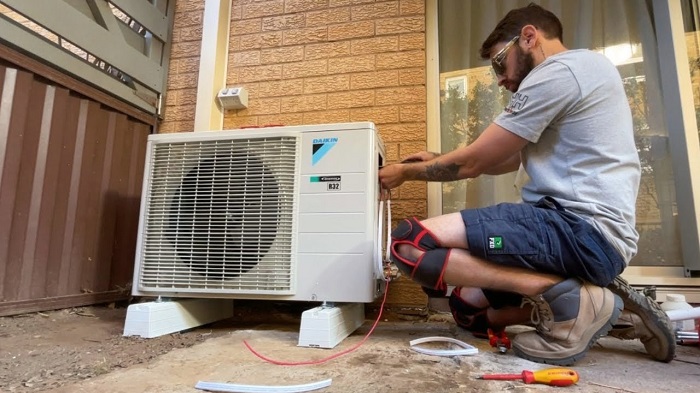
Air conditioning in the home: rules for choosing installation and maintenance
Air conditioning in a home isn’t just about keeping cool in the summer; it’s also about maintaining a stable microclimate, comfortable sleep, and reducing humidity. A properly selected system from MGM Heating & Cooling Rochester helps maintain a constant temperature and reduces stress on the body on hot days.
For an air conditioner to work effectively, it’s important to consider the room’s size, thermal insulation, window orientation, and the number of people and appliances. Proper selection and operation reduce energy bills and extend the life of the equipment.
Choosing a System: What’s Right for Your Home
For apartments and private homes, split or multi-split systems are most often chosen, while ducted solutions are more common for larger homes. When choosing, consider not only the power output but also noise level, energy efficiency, and ease of maintenance.
Main Air Conditioning Options
- Split system – one indoor unit per room; Simple installation and straightforward maintenance.
- Multi-split – several indoor units from one outdoor unit; saves space outside, but is more difficult to repair.
- Duct air conditioner – concealed installation and air distribution through ducts; suitable for homes with several rooms.
- Mobile air conditioner – a solution without installation, but noisier and less efficient.
How to calculate power without errors
Simplified rule: a 10 m² well-insulated room often requires about 1 kW of cooling. However, adjustments are necessary: sunny areas, panoramic windows, high ceilings, and the presence of a kitchen or a large number of appliances increase the need.
- Evaluate the area and ceiling height (volume is more important than area).
- Consider heat gains: windows, sunlight, stove, oven, and computers.
- Add a power reserve if insulation is poor.
- Choose a model with suitable modes: cooling, dehumidification, ventilation, and occasional heating.
Summary: How to select split system capacity based on area and ceiling height
For residential spaces, it is most convenient to calculate cooling capacity based on the room’s volume: the larger the area and the higher the ceilings, the more heat needs to be removed. This approach helps avoid two pitfalls: an underpowered air conditioner (which can’t cope and wears itself out) and one that’s too powerful (which switches on and off frequently, resulting in less consistent comfort).
Basic calculation guidelines on mgmhvacny.com: Q × V × 35–40 W, where V = S × H (volume, m²), S is the area (m²), and H is the ceiling height (m). Then, adjust for sun, people, and appliances and round to the nearest standard model.
Short Selection Checklist
- Step 1: Calculate the volume: V = S × H.
- Step 2: Basic power: Qbase = V × 0.035–0.040 (kW).
- Step 3: Add allowances:
- Sunny side/panoramic windows – +10–20%;
- Each additional person – +0.1 kW;
- Equipment in operation (PC, TV, kitchen appliances) – +0.1–0.3 kW in total.
- Step 4: Round the result to the nearest typical split system capacity (for cooling): 2.0 / 2.5 / 3.5 / 5.0 / 7.0 kW.
Summary: The correct selection of split system capacity is based on the volume of the room, taking into account the ceiling height and actual heat gain. This choice ensures stable temperatures, lower noise levels, and more efficient operation of the equipment.