



Leather sofa vs. fabric sofa: the honest cost of ownership nobody talks about
The sofa decision gets treated as an aesthetic choice — leather looks a certain way, fabric looks another way, you pick the one that matches the room. What doesn’t make it into the showroom conversation is what either choice costs you over the next eight to ten years once you’re living with it. The purchase price is the smallest part of that number. The maintenance, the cleaning, the resilience to what households actually do to furniture — that’s where leather and fabric diverge in ways that matter considerably more than the upfront sticker.
Having gone through this with two sofas over the past decade, and having talked to enough people who’ve done the same in different directions, the picture is fairly consistent: each material has a clear profile of what it handles well and where it makes your life harder. Neither is universally better. But the choice made without understanding the maintenance reality is the one people reliably regret.
What Leather Actually Costs to Maintain
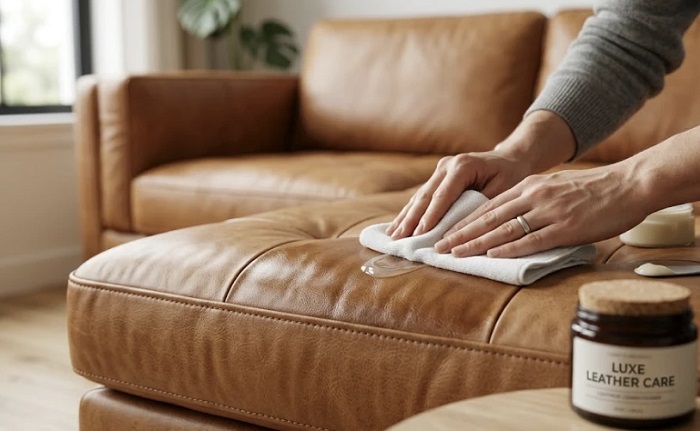
Top-grain leather — the grade worth buying if you’re buying leather at all — needs conditioning once or twice a year. A quality leather conditioner runs $15 to $30 a bottle, and a full sofa requires maybe a quarter of a bottle per application. That’s $10 to $15 a year in product, plus twenty minutes of your time. It’s not a burdensome requirement. What it is, is non-negotiable: leather that isn’t conditioned dries out, develops surface cracking at seam lines and cushion edges, and looks aged in a way that’s difficult to reverse after it progresses past a certain point.
The conditioning requirement gets more significant if your home experiences temperature swings — central heating that drops the indoor humidity significantly in winter, or summers without air conditioning where the interior heats up. Both extremes accelerate the drying process. Leather in a climate-controlled environment with stable humidity stays supple much longer with minimal intervention. Leather in a home that cycles between cold dry winters and hot summers needs conditioning on the more frequent end of the range.
Professional cleaning for leather is less frequent than for fabric — typically every two to three years rather than annually — but it’s a specialized service and priced accordingly. General upholstery cleaning companies don’t always work on leather, and when they do, the process (pH-balanced leather cleaner, conditioning treatment, surface protection application) costs meaningfully more per session than a fabric cleaning of similar size. The longer interval between sessions offsets some of this, but not all of it.
Scratches are the maintenance cost most leather buyers underestimate. Pet claws, sharp belt buckles, keys set down carelessly — top-grain leather develops surface scratches that, depending on the finish, range from nearly invisible to quite noticeable. Some finishes allow minor scratches to be buffed out with conditioner; others don’t. Full-grain leather actually develops a patina from scratches that many people find attractive over time. Protected leather (the most common grade in mass-market furniture) develops scratches that look like damage rather than character. Knowing which grade you’re buying matters for setting accurate expectations about what the sofa will look like in year five.
What Fabric Actually Costs to Maintain
Fabric’s maintenance cost is primarily in professional cleaning, and the frequency required depends significantly on the household. A two-person household with no pets and no children might stretch to eighteen months between professional cleanings without the sofa showing significant degradation. A family with dogs, kids, or both is realistically looking at annual cleaning at minimum to keep the fabric in good condition and the room smelling right.
The annual cleaning cost for a standard three-seat fabric sofa through a professional upholstery service runs $80 to $150 depending on the market and the service. Over ten years at that interval, that’s $800 to $1,500 in cleaning costs on top of the purchase price. It’s not a number that makes fabric a bad choice — it’s a number that should be factored into the comparison when someone says “but leather is so much more expensive.”
The hidden maintenance cost in fabric is what happens when you don’t clean it on schedule. Fabric that accumulates two or three years of embedded particulates, pet dander, and body oil without professional extraction reaches a point where surface appearance and odor are both noticeably degraded. At that stage, professional hot water extraction can restore the fabric substantially — but the reset takes longer, may require multiple passes, and sometimes can’t fully reverse discoloration that’s been building for years. The cost of irregular maintenance isn’t linear; it compounds.
Performance fabrics — Crypton, Revolution, solution-dyed acrylics — reduce the maintenance burden considerably compared to natural fiber upholstery. They resist staining, tolerate more aggressive cleaning methods, and don’t hold particulates as deeply as linen or cotton. If you’re choosing fabric and want to minimize long-term maintenance cost, the fabric specification matters almost as much as the cleaning schedule.
Spills: Where the Real Difference Shows Up
Leather handles liquid spills better in the immediate term. A glass of water or a splash of coffee on a finished leather surface wipes clean in seconds if you catch it within a minute or two. The leather surface doesn’t absorb water rapidly the way fabric does, which means the window between “spill” and “permanent damage” is considerably longer. For households with young children where spills happen regularly and aren’t always caught immediately, this is a genuine practical advantage.
The complication is that not all spills are water. Oil-based spills — butter, cooking oil, hand lotion — absorb into leather more readily than water does and can leave permanent darkening if not addressed quickly with the right leather degreaser. Red wine on fabric is a nightmare; red wine on finished leather wipes off if you’re prompt. Greasy food on fabric is annoying; greasy food on leather can be permanent if you don’t have the right product on hand. The spill resistance advantage of leather is real but specific to the type of spill.
Fabric with a liquid-resistant treatment or a performance weave handles moderate spills better than untreated natural fiber but never as forgivingly as finished leather for immediate liquid contact. Where fabric has the advantage is that when serious staining does occur, professional cleaning can often extract it completely. Leather stains that penetrate the surface finish are significantly harder to address — professional leather restoration is a specialty service that not every upholstery cleaner offers, and the results vary considerably depending on the leather grade and the nature of the staining.
The Long Game: Year Eight Looks Like What?
This is the question that clarifies the decision. Both materials, well-maintained, can look genuinely good at eight to ten years. Both materials, poorly maintained, look bad by year four. The question is what “well-maintained” requires from each.
A top-grain leather sofa at year eight, conditioned consistently and kept out of direct prolonged sunlight, develops a depth and richness that most people find more attractive than it was new. The surface develops character. Minor wear at armrests and seat edges reads as patina rather than damage. If you have pets, there’s likely some surface scratching that’s either charming or irritating depending on your perspective, but the structural integrity is fine. A leather sofa at year eight that was never conditioned has cracked seams, flaking at stress points, and a dull surface that looks exactly as neglected as it was.
A performance fabric sofa at year eight, professionally cleaned on schedule with appropriate pretreatment chemistry, looks largely as it did in year two — perhaps slightly softer in texture, slightly less crisp in weave, but the color holds and the fabric structure is intact. A fabric sofa at year eight that received only surface vacuuming and no professional cleaning looks and smells like a piece of furniture that has been someone’s primary seating for eight years without maintenance. The difference is significant enough that most people in the second category replace the sofa, which makes the “fabric is cheaper than leather” math considerably less favorable than it appeared at purchase.
Allergies, Pets, and the Practical Calculus
For households where indoor allergies are a concern, leather has a straightforward advantage: it doesn’t harbor dust mites, pet dander, or pollen the way fabric does. The smooth surface doesn’t provide the fiber depth that allergens embed into, and a weekly wipe-down with a slightly damp cloth removes surface accumulation effectively. Fabric upholstery is a known reservoir for dust mites — a study published in the journal Allergy found that upholstered furniture can harbor higher concentrations of house dust mite allergens than bedding, particularly in humid environments. For someone with significant dust mite or pet dander sensitivity, this is a meaningful factor.
For pet owners, the calculation is more nuanced. Leather resists pet hair (it doesn’t embed, it sits on the surface and can be wiped off), but it’s vulnerable to claw scratching in a way that fabric isn’t. A dog that kneads before settling, or a cat that uses the armrest as a scratching surface, will damage leather in ways that are expensive or impossible to repair. The same behaviors on a durable fabric weave create less visible damage. Pet households that want leather either need pets that don’t scratch furniture or need to be comfortable accepting surface wear as part of the aesthetic.
The Cleaning Equation Side by Side
Looking at the full cleaning cost picture over ten years of typical family use, neither material is dramatically cheaper than the other — they just distribute costs differently. Leather concentrates cost in the purchase price and occasional professional leather cleaning, with low annual maintenance between sessions. Fabric distributes cost across annual or biannual professional upholstery cleaning, which for a Seattle-area household is a straightforward service from local providers — leather sofa vs fabric sofa maintenance costs and schedules that any professional upholstery service can outline specifically for your material and household conditions.
The buyer who makes this decision well is the one who’s honest about their household. Spill-prone with young kids and no pets: leather probably wins on practical grounds. Allergy household with no scratching pets: leather wins clearly. Heavy pet household with scratching animals: fabric wins on durability. Climate with significant humidity swings: either can work if maintained, but fabric forgives irregular maintenance slightly better than leather because the damage from neglect (embedded soil) is more recoverable than leather’s damage from neglect (cracking and surface breakdown).
The furniture store won’t tell you any of this, because the sale closes the same either way. The decade of living with the choice is where the decision proves itself.