


What most homeowners in Greater Seattle learn too late about interior painting
When Dave Correa bought his craftsman bungalow in Bothell back in 2021, the previous owners had repainted the living room about three years before the sale. Looked fine at the time. By Dave’s second winter in the house, a six-inch strip along the ceiling line had gone chalky and was pulling away from the drywall. The culprit wasn’t moisture or poor ventilation — it was flat interior latex applied directly over semi-gloss without scuffing or priming. A $12 can of primer would have saved the job. Instead, Dave paid $2,400 to strip and redo the entire room.
I’ve seen variations of that story repeat across the Greater Seattle market more times than I’d like to count. Homeowners who hired the cheapest crew, or the fastest one, or the one that didn’t ask any questions before handing over a number. The Pacific Northwest throws specific curveballs at interior paint jobs that most national painting chains — and plenty of local ones — simply don’t account for. Here’s what’s actually happening when a paint job fails in this region, and what separates a job that holds for eight years from one that starts peeling before the contractor’s check clears.
The Moisture Problem Nobody Talks About
Western Washington hovers between 80 and 90 percent relative humidity for roughly seven months of the year. That matters inside your walls as much as outside. Older homes in Bothell, Snohomish County, and south into the Eastside suburbs — particularly anything built before 1985 — frequently have inadequate ventilation that keeps wall surfaces slightly damp even when they feel perfectly dry to the touch.
Applying paint over a surface with even 2 to 4 percent residual moisture content causes adhesion failure within 12 to 18 months. The PDCA (Painting and Decorating Contractors of America) recommends surface moisture levels below 12 percent for wood substrates and below 15 percent for drywall before applying any coating. Checking this takes about 90 seconds with a pin-type moisture meter that costs $25 at any hardware store. The number of painting crews in the Puget Sound area who actually carry one is depressingly small.
This is the part that homeowners in drier climates never have to think about but Seattle-area residents absolutely do. A paint job that would last a decade in Phoenix might start failing in three years in Kirkland — not because the painter did bad work, but because nobody checked the wall conditions before picking up a roller. Contractors who work this market regularly understand the problem. Those who don’t tend to be the ones offering unusually low bids.
What a Real Estimate Should Look Like
A complete interior repaint on a 1,800 square foot home in the Seattle suburbs — three bedrooms, living areas, hallways, standard ceiling height — runs between $3,500 and $7,200 depending on trim complexity, number of rooms, and whether cabinets or built-ins are included. Those figures come from job data across King and Snohomish counties tracked over the past three years. Labor rates in this region run $45 to $75 per hour for experienced painters, which is higher than the national average, reflecting both the cost of living and the genuine skill shortage in the trades here.
If you’re receiving a bid that comes in at $1,800 for that same house, someone is cutting something. Usually it’s prep time. Proper surface preparation — filling nail holes, skim-coating damaged drywall sections, sanding glossy surfaces so new paint has something to bond to, wiping down walls with a TSP substitute to remove grease and residue — accounts for 30 to 40 percent of a quality interior paint job’s total labor hours. Skip it and the paint goes on fine. It just doesn’t stay.
The premium paint products matter less than most salespeople would like you to believe, but they’re not irrelevant. A quality interior paint like Sherwin-Williams Emerald, Benjamin Moore Aura, or the underrated Behr Marquee runs $65 to $90 per gallon. Contractors who bid low often use the $28 house paint from the same stores — same brand name on the can, completely different product. You can ask directly: “What product are you applying, and what’s the coverage rate per gallon?” A contractor who can’t answer that question on the spot is using whatever was cheapest that week.
The Trim Issue That Ages a Job By a Decade
Walls get painted. Trim gets ignored, or rushed, or painted over sloppily while the homeowner is still in the room and wanting the job to be done. In most Greater Seattle homes, the trim has already been painted at least twice over by previous owners. Each layer adds build-up and potential failure points. If nobody has ever stripped the baseboards, window casings, and door frames down to bare wood, you’re applying new paint over a surface that’s already delaminating in places you can’t see.
The right approach is to clean the trim, lightly sand it, fill any gaps at the wall joint with a flexible paintable caulk — not spackle, which will crack as the wood moves through seasonal temperature cycles — and apply a satin or semi-gloss finish over a bonding primer. Most low-bid crews skip the caulk entirely. After one Pacific Northwest winter cycle, those unsealed trim joints open up and turn a fresh paint job into something that looks three years old in twelve months.
Window casings are particularly vulnerable in this region because of the temperature differential between glass and wall surface. That 28°F January morning creates real stress on painted trim joints that were installed thinking about a much more moderate climate. Contractors who have genuinely worked the Seattle market long enough have seen this failure mode enough times that it’s built into their prep process. New crews or transplants from drier markets often haven’t.
The Color Decision and Why It’s More Complicated Here
This sounds like an aesthetic footnote, but it’s actually where a lot of Pacific Northwest homeowners make expensive mistakes that compound the cost of the whole project.
Interior spaces in Western Washington deal with limited natural light for roughly eight months of the year. A color that reads warm and inviting in a Dallas showroom can feel genuinely oppressive in a Kirkland craftsman with north-facing windows and significant tree cover. The difference between how a paint chip looks at 10 AM on a July morning and how the same color reads at 3 PM on a November afternoon in the same room is substantial enough that professional designers who work this region treat them as almost separate questions.
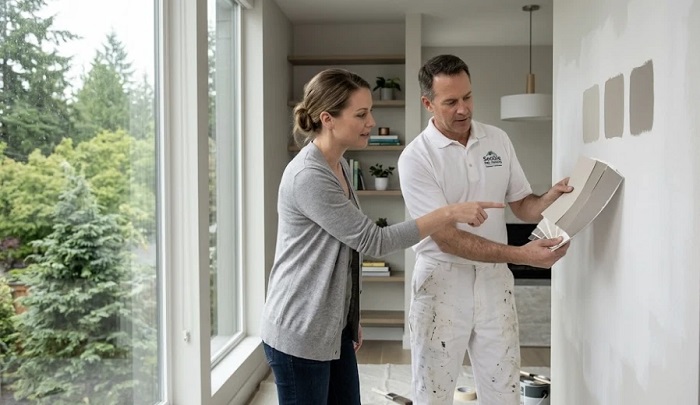
The standard advice — test paint chips in the space under different light conditions — matters more here than anywhere else in the country. Some contractors include a basic color consultation as part of their standard walkthrough, which is worth asking about. If a contractor hands you a bid and never mentions light conditions or asks which direction your main windows face, you’re working with someone who views the job as pure labor. That’s fine if you’ve already worked out the color question yourself. It’s a problem if you haven’t.
When the Problem Isn’t Actually the Paint
One situation worth knowing about before you hire anyone: some conditions that look like painting problems are actually moisture intrusion problems wearing a painting problem’s clothes. Bubbling paint near windows, staining that bleeds through multiple coats, soft or spongy drywall in corners — these aren’t surfaces that need better paint. They need the source of the moisture found and stopped first, then remediation, then paint.
Painting over active moisture intrusion gives you about 14 months of visual improvement before the same failure resurfaces, usually worse. In Snohomish County specifically, this shows up most frequently in homes built between 1965 and 1985 that haven’t had window or weather stripping work done. A contractor with genuine regional experience will flag these issues during the bid walkthrough. If nobody mentions the bubbled paint around your second-floor window frame, that’s useful diagnostic information about what you’re dealing with.
The EPA has specific requirements around lead paint disclosure for homes built before 1978 — the Renovation, Repair and Painting (RRP) Rule requires certified contractors for work that disturbs more than six square feet of painted surface per room in pre-1978 housing. This applies to a significant portion of the older housing stock in neighborhoods like North Everett, Old Town Bothell, and parts of Lynnwood. Homeowners should ask about RRP certification when getting bids on older homes, both for health reasons and because non-compliant work creates liability issues at resale.
What the Actual Math Looks Like
For a DIY interior repaint on a 1,400 square foot home covering three bedrooms, living room, and hallway: figure 10 to 14 gallons of quality paint at $65 per gallon, which runs $650 to $910 in materials. Add prep supplies — joint compound, primer, sandpaper, tape, drop cloths, brushes and rollers — and you’re at $800 to $1,100 before you’ve touched a wall. Your labor on that job, if you’ve never done an interior repaint at that scale, is 60 to 80 hours. A professional crew completes the same project in 12 to 18 labor hours. The quality difference on trim work and cut lines is visible from across the room.
The math shifts for smaller projects. A single accent wall, touching up scuffs and dings in a rental unit, or repainting one room before listing a house — those are reasonable DIY projects. A whole-house repaint on any home larger than about 1,200 square feet generally comes out ahead on both cost-per-year and outcome quality when done professionally, assuming you hire someone who actually knows what they’re doing in this specific climate.
For homeowners in the Bothell, Everett, and Kirkland area, companies like Pizoni Painting — painting contractors in Bothell, WA with experience across the Greater Seattle corridor — combine surface inspection, moisture assessment, and proper prep with the kind of regional knowledge that actually matters for paint longevity in the Pacific Northwest. The difference between a job that holds for eight years and one that starts failing in two usually comes down to what happened in the first four hours, before anyone picked up a brush.
The region’s housing stock is older than most people realize — the median home age in King County is over 40 years. That means layers of previous paint work, variable moisture histories, and surface conditions that reward experienced assessment over fast bidding. Taking the time to ask the right questions before signing a contract is the only reliable way to end up in the first category rather than the second.