


Engineering standards in commercial concrete slab work and industrial foundations
In modern commercial construction, civil infrastructure development, and industrial plant expansion, structural concrete foundations serve as the primary load-bearing matrix for complex architectural systems. Ensuring the long-term durability, structural integrity, and regulatory compliance of these installations requires rigorous engineering standards from initial site preparation through final surface processing. Executing high-grade concrete slab work involves a multi-faceted operational sequence where precise soil compaction, heavy steel reinforcement, and strict moisture mitigation protocols dictate final structural performance. When commercial developers and general contractors undertake large-scale structural installations, any compromise during base stabilization or concrete placement can lead to catastrophic structural cracking, differential settlement, or premature surface degradation under heavy operational loads.
Establishing a stable sub-grade is the critical first phase in any commercial slab installation. Engineers must conduct thorough soil diagnostics to determine compaction ratios and load-bearing capacities before introducing sub-base aggregates. Laying down compacted crushed stone or gravel creates a stable, well-draining substrate that distributes heavy structural loads evenly across the underlying ground. Furthermore, integrating high-density vapor barriers beneath the slab matrix prevents ground moisture from migrating upward into the concrete, eliminating efflorescence and protecting interior flooring finishes. For elevated structural decks or multi-story commercial facilities, formwork engineering becomes equally paramount. Formwork systems must be constructed with rigid tolerances to withstand the immense hydrostatic pressure exerted by wet concrete, preventing deflection or structural failure during pour operations.
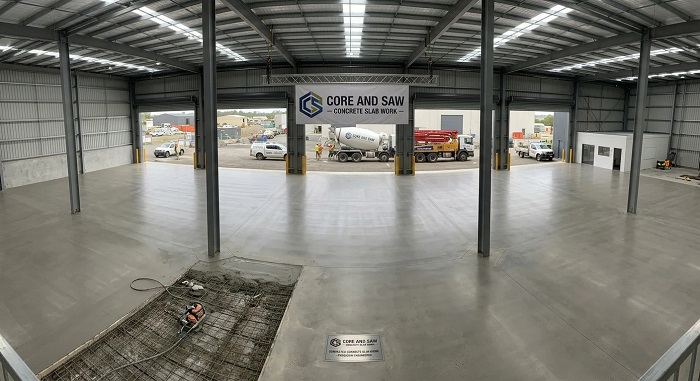
Structural reinforcement remains the backbone of heavy-duty industrial floor systems. Because unreinforced concrete exhibits high compressive strength but relatively low tensile resistance, embedding precision-engineered steel rebar grids or post-tensioned cable systems is essential to absorb tensile stresses induced by seismic activity, heavy machinery vibration, and extreme thermal expansion. Positioning rebar grids at precise structural depths ensures complete concrete coverage, safeguarding internal steel against environmental corrosion and chemical degradation. During large-volume pours, maintaining continuous concrete delivery schedules prevents the formation of cold joints – structural weak points created when fresh concrete is poured against an already hardened batch.
Once the concrete mixture is placed, specialized crews deploy high-output vibratory equipment to consolidate the material, removing trapped air pockets and securing dense aggregate packing around rebar arrays. Modern industrial facilities require exceptionally flat and level floors to accommodate automated forklift traffic, heavy pallet racking, and high-precision manufacturing equipment. Professional finishing teams utilize motorized power trowels and laser-guided screeds to achieve precise floor flatness tolerances before the initial set occurs. Following surface finishing, implementing controlled curing procedures — such as wet curing, insulating blankets, or chemical curing compounds — ensures the slab retains optimal moisture levels to reach its maximum rated compressive strength over the standard twenty-eight-day curing cycle.
When expanding or retrofitting operational industrial plants, project managers frequently require structural modifications to existing floor slabs to accommodate deep utility trenches, machinery pits, or structural anchor footings. Executing complex modifications alongside new foundation installation requires deep technical expertise, specialized diamond cutting equipment, and integrated subsurface scanning technology. By partnering with experienced contractors who specialize in comprehensive concrete slab work, general contractors guarantee that both foundational pours and structural alterations adhere strictly to OSHA standards, ACI guidelines, and project specifications. Utilizing non-destructive Ground Penetrating Radar (GPR) prior to cutting or drilling into existing slabs ensures buried utility conduits and post-tension cables remain undisturbed. Ultimately, combining advanced diamond tooling, engineered dust containment, and precision concrete placement allows commercial facilities to maintain structural longevity while completing demanding construction phases cleanly, safely, and on schedule.