


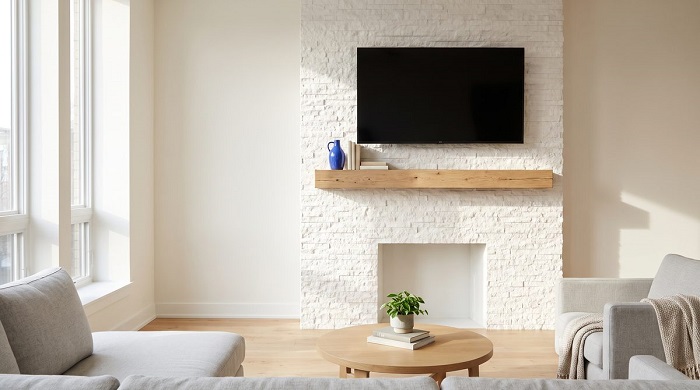
How to mount a TV on a stone fireplace: stacked stone, veneer and solid stone
You have the TV, the spot and maybe the mount. Then you stand in front of the stone fireplace and realize nobody wants to be the one who cracks it. Around Chicago that stone can be almost anything. It may be a stacked-stone facing over old brick, a framed box in a suburban house, or real fieldstone.
The short answer: on most stacked stone, the stone is not what holds the TV. If it is a veneer, a thin facing, the bolts pass through it into the studs or brick behind. If it is solid stone, masonry anchors go into the stone itself, never the mortar. Here is how to tell which one you have.
Key takeaways
- Most stacked stone is a thin facing, and the bolts go through it into the wall behind.
- Solid stone holds a TV with masonry anchors in the stone, never in the mortar joints.
- Knock on the stone, look at its edges and check what is behind it before anyone drills.
- Rough stone needs spacers so the mount sits flat. Forcing the bolts cracks stone.
- Stone does not stop heat, so test the wall above a working fireplace first.
Can you mount a TV on a stone fireplace?
Yes, if the bolts reach something solid. Look at an edge of the stone. If it is a thin layer over a backing, it is veneer, and the bolts pass through it into the studs or brick behind. If the stones run deep, it is solid stone, and the anchors go into the stone itself, not the joints.
How to tell what kind of stone you have: 4 quick checks
1. Knock on the stone
Knock with your knuckles at a few heights across the fireplace. A hollow sound usually means a thin facing over a wood-framed box, often with studs behind it. A dull, solid sound means brick, block or solid stone.
2. Look at the edges
Look at the sides of the fireplace and at any opening, like an outlet or a gas key. Veneer shows as a thin layer over a backing. Solid stone shows deep stones with nothing behind them but more stone.
3. Check behind the stone
Find out what the stone sits on. A closet, attic or basement next to the fireplace may show the framing, and the fireplace manual or house plans may name it. Note any flue, gas line or wiring. Never drill into a flue.
4. Check the heat
Run the fire for an hour, then put your hand on the stone where the TV would hang. Samsung says its TVs should never go above 104 F. If the stone is too warm to keep a hand on, the TV belongs on another wall.
Each kind of stone and what holds the TV
| Stone type | What holds the TV | Watch for |
|---|---|---|
| Stacked-stone veneer over a framed box | Lag bolts through the stone into the wood studs | Bolts too short for stone, mortar and backing; a flue inside |
| Stone veneer over brick | Masonry anchors through the stone into the brick | Anchors that stop in the mortar bed, short of the brick |
| Stone veneer over hollow block | Anchors made for hollow masonry | Ordinary anchors that spin in the hollow core |
| Solid fieldstone or rubble stone | At least four masonry anchors in the stone | Mortar joints, cracked or loose stones |
| Stone facing with no stud where you need one | Nothing a TV should rely on | Toggle bolts in the facing. Move the spot |
MantelMount, a maker of fireplace mounts, puts it simply: veneer usually has studs behind it, where lag bolts may work, and real stone needs a concrete, sleeve or masonry anchor. It also warns that not every mount comes with the right anchors, so check the box.
Stacked-stone veneer over a framed box
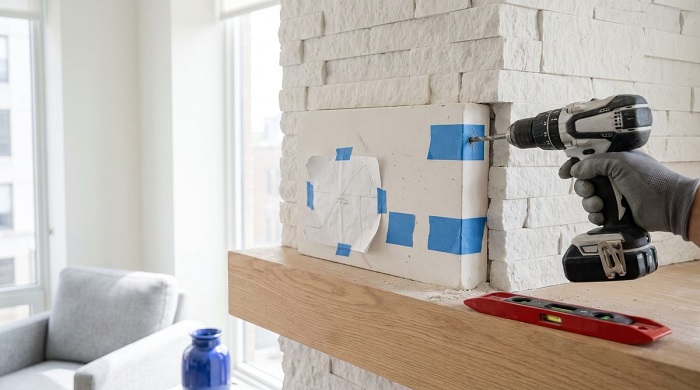
Most stacked-stone fireplaces are veneer: cast or natural stone, cut thin and set in mortar on a wall. An evaluation report for one manufactured stone product calls it nonload-bearing. In plain words, the veneer is a finish the wall carries, not a support.
You find it in suburban houses and in remodels, often over a wood-framed box around the flue, called a chase. It sounds hollow when you knock. The catch is bolt length: the bolt has to pass through stone, mortar and backing and still bite deep into the stud. The chase may also hold the flue, so the studs have to be found, not guessed.
Stone over brick or block
Many older Chicago fireplaces are brick, and a stacked-stone surround is sometimes added later as a facing over the original brick. The anchors pass through the stone and set in the brick behind. Our post on mounting a TV on brick covers the anchors and why they go in the brick, not the mortar.
Block is the catch. Hollow concrete block needs an anchor made for hollow masonry, like a chemical anchor with a sleeve.
Solid fieldstone and rubble stone
A fieldstone or rubble fireplace built stone on stone is masonry all the way through, much like a brick chimney breast. It holds a TV well, with at least four masonry anchors set in the stone itself.
The catch is the joints. MantelMount’s guide to brick and stone says to drill into the center of the stone, not the mortar, since mortar is softer and holds less. Pick a flat, sound stone for every hole, and make sure it is not crumbling. If a mark lands on a joint or a weak stone, slide the plate.
Drilling stone without cracking it
Stone is drilled with a hammer drill and a masonry bit. Tape each mark so the bit does not skate, and drill to the depth the anchor maker gives. On veneer, the bit goes through the stone and mortar first. Then it changes to suit the backing: a wood bit for studs, a masonry bit for brick or block.
Clear the dust from every hole before the anchor goes in. When the TV is up, look over the stone around each hole for fine cracks.
Uneven stone: getting the plate to sit flat
Stacked stone is rough by design, so a wall plate pressed against it rocks. Tightening until it stops is how stone cracks, and MantelMount warns against overtightening for that reason.
The fix is a flat plane in front of the stone. Choose the most even part of the wall and use the mount’s depth adjusters, or spacers and shims where the face keeps the plate off. On very rough stone, hanger bolts with washers and nuts can be turned until the plate is level. The TV sits a little further out, a fair trade for a level screen.
Height and wires on a stone fireplace
A TV over a mantel sits high. A tilting mount angles the screen down, and a pull-down mount brings it to eye level. Mounting a TV above a fireplace covers height and heat, and our guide to pull-down TV mounts explains when one is worth it.
Solid stone has no space for a cable, so the usual answer is a slim cord cover painted to match along the edge of the surround. A framed chase can sometimes carry low-voltage cables, clear of the flue. A new outlet above the mantel is a job for an electrician. See what to do when there is no outlet behind the TV.
Chicago homes and their stone fireplaces
Bungalows and brick two-flats. Most original fireplaces here are brick, and many bungalow fireplaces were removed over the decades. A stacked-stone surround in one of these homes may be a later facing over a framed chase or over the original brick, so check behind it.
Greystones and courtyard buildings. The stone is on the outside. Inside, a stone surround is most likely a facing, so run the four checks.
Condos and high-rises. A stone surround may sit on metal studs or on concrete. Where it is concrete, ask the building for its rules before anyone drills, and tell us about them when you schedule.
Suburban houses. Full-height stacked stone over a framed chase is a familiar sight. On our stacked-stone fireplace job in Evanston, the bolts reached the solid wall behind the stone.
Our fireplace TV mounting service checks the wall before anything is drilled, and if another wall would serve you better, we will say so.
Common questions
Can you drill into stacked stone?
Yes. Use a hammer drill and a masonry bit, tape over each mark and drill steadily. On a veneer the hole continues into the studs or masonry behind, and that backing holds the TV. Avoid loose or cracked stones.
Is stacked stone strong enough to hold a TV?
Not on its own when it is a veneer. It is a finish, so the bolts must pass through it into the framing or masonry behind. Solid stone is different: it is masonry, and it holds a TV well with anchors set in the stone.
How do you mount a TV on an uneven stone wall?
Find the flattest sound area, then build a flat plane with spacers, shims or the mount’s depth adjusters. Hanger bolts with washers and nuts can also be turned to level the plate. Tighten firmly, but never hard enough to crack the stone.
Should you drill into the stone or the mortar?
Into the stone. Mortar is softer and holds less. On a veneer, pick a sound stone too, since the bolt has to pass through it cleanly on its way to the backing.
> Not sure what is behind your stone? > Text us your TV size, whether the fireplace gets used, your zip code and a photo of the fireplace with one close-up of a stone edge. We reply with a free quote, and the more detail you send, the more accurate it will be. > Get a free quote Text us
#Stone fireplaces #Fireplace TV #Chicago homes
Not sure what is behind your stone?
Text R&R TV Mounting your TV size, whether the fireplace gets used, your zip code and a photo of the fireplace with one close-up of a stone edge. We reply with a free quote, and the more detail you send, the more accurate it will be.